
A lot of people were surprised the stock market didn’t fall further given the geopolitical situation.
A war in the Middle East. Oil prices spiked 60% in a hurry. The energy market supply-demand dynamics might be screwed up for a while. Gas prices quickly shot up to over $4 a gallon.
Why did we see such an orderly sell-off in the stock market?
Why was the S&P 500 only down 9% from the highs? Why didn’t we see even a single 2% down day?
The New York Times has a piece this week that essentially asked these questions:
A lot of investors share these sentiments.
The stock market is detached from reality right now.
How could we shoot back to new all-time highs so quickly when energy markets are still a mess and the situation in Iran hasn’t been resolved?
In a word — earnings.
The Exhibit A chart of the week shows rolling stock market returns tend to track year-over-year forward earnings growth:
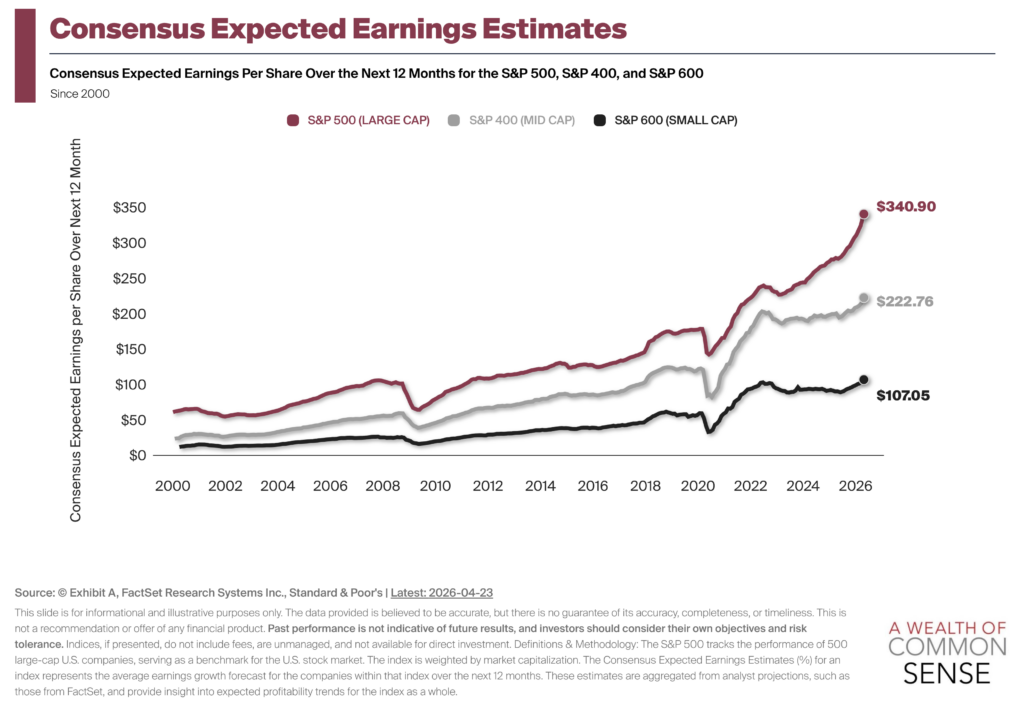
Earnings expectations are actually accelerating:
We just went through a situation where stock prices were falling while earnings estimates have been ramping up. This was especially true for the biggest sector in the stock market.
Chart Kid Matt has some excellent data that shows the change in prices versus the change in valuations during the minor correction we just had:
Prices experienced a modest correction but valuations got slammed because the fundamental outlook has improved so much.
There are always numerous variables impacting the markets at any one point in time — economic data, investor psychology, earnings, geopolitics, investor flows, fiscal/monetary policy, world events, etc.
But the fact that earnings expectations have remained so strong — even in the face of a war and rising energy costs — is the simplest reason why this market does in fact make sense.
You have to remember that the stock market is heartless. It’s an amoral and apolitical profit-loving machine that exists to make you pull your hair out at times when trying to figure out what’s going on.
Of course, this is all very short-term in nature.
Could earnings estimates prove too sanguine about the war?
Absolutely. If this drags on and energy markets have serious long-term damage this could still be a problem.
Does AI matter more than geopolitics at the moment? It appears so.
Does the stock market always track fundamentals? No.
Prices and fundamentals can and will diverge at times.
Is the stock market ever wrong about the implied expectations? Yes. There are no perfect track records in the financial markets.
But the stock market is right far more often than the pundits that try to predict it.
When the stock market bounced in April of 2020 while the pandemic situation was about as bleak as it could get, no one believed the lows were in.
The stock market was right.
When inflation was 9% and everyone was convinced a recession was all but guaranteed, no one believed the lows were in.
The stock market was right.
Duality Research wrote a piece this week talking about how the stock market doesn’t care about today but how things might look in the future. This quote was right on the money:
Remember that the stock market’s job is to make you say, “this makes no sense.”
The stock market isn’t always right but it’s right more often than any of us trying to predict what comes next.
Michael and I talked about fighting the stock market, earnings and much more on this week’s Animal Spirits video:
[embed]https://www.youtube.com/watch?v=iTflH_E8GLw[/embed]
Subscribe to The Compound so you never miss an episode.
Further Reading:
The Stock Market is Heartless
Now here’s what I’ve been reading lately:
Books:
Podcasts:
This content, which contains security-related opinions and/or information, is provided for informational purposes only and should not be relied upon in any manner as professional advice, or an endorsement of any practices, products or services.
There can be no guarantees or assurances that the views expressed here will be applicable for any particular facts or circumstances, and should not be relied upon in any manner. You should consult your own advisers as to legal, business, tax, and other related matters concerning any investment.
The commentary in this “post” (including any related blog, podcasts, videos, and social media) reflects the personal opinions, viewpoints, and analyses of the Ritholtz Wealth Management employees providing such comments, and should not be regarded the views of Ritholtz Wealth Management LLC. or its respective affiliates or as a description of advisory services provided by Ritholtz Wealth Management or performance returns of any Ritholtz Wealth Management Investments client.
References to any securities or digital assets, or performance data, are for illustrative purposes only and do not constitute an investment recommendation or offer to provide investment advisory services. Charts and graphs provided within are for informational purposes solely and should not be relied upon when making any investment decision. Past performance is not indicative of future results.
The content speaks only as of the date indicated. Any projections, estimates, forecasts, targets, prospects, and/or opinions expressed in these materials are subject to change without notice and may differ or be contrary to opinions expressed by others.
The Compound Media, Inc., an affiliate of Ritholtz Wealth Management, receives payment from various entities for advertisements in affiliated podcasts, blogs and emails. Inclusion of such advertisements does not constitute or imply endorsement, sponsorship or recommendation thereof, or any affiliation therewith, by the Content Creator or by Ritholtz Wealth Management or any of its employees. Investments in securities involve the risk of loss.
For additional advertisement disclaimers see here: https://www.ritholtzwealth.com/advertising-disclaimers
Please see disclosures here.
Disclaimer: This story is auto-aggregated by a computer program and has not been created or edited by finopulse.
Publisher: Source link