Last year, China invited hundreds of humanoid robots to compete in the world’s first Robot Olympics.
And it was hard not to laugh at some of the videos coming out of Beijing.
Robots stumbled down the track, crashed into one another and collapsed in the middle of events. Some looked like they could barely stay on their feet.
But when I wrote about the games last August, I warned that China was taking them very seriously.
It wasn’t simply putting on a show. China was giving hundreds of companies and research teams a chance to test their machines, learn from their failures and come back stronger.
This month, the robots returned to Beijing.
And one of last year’s punchlines did something no human being in history has ever done.
Record-Breaking Robots
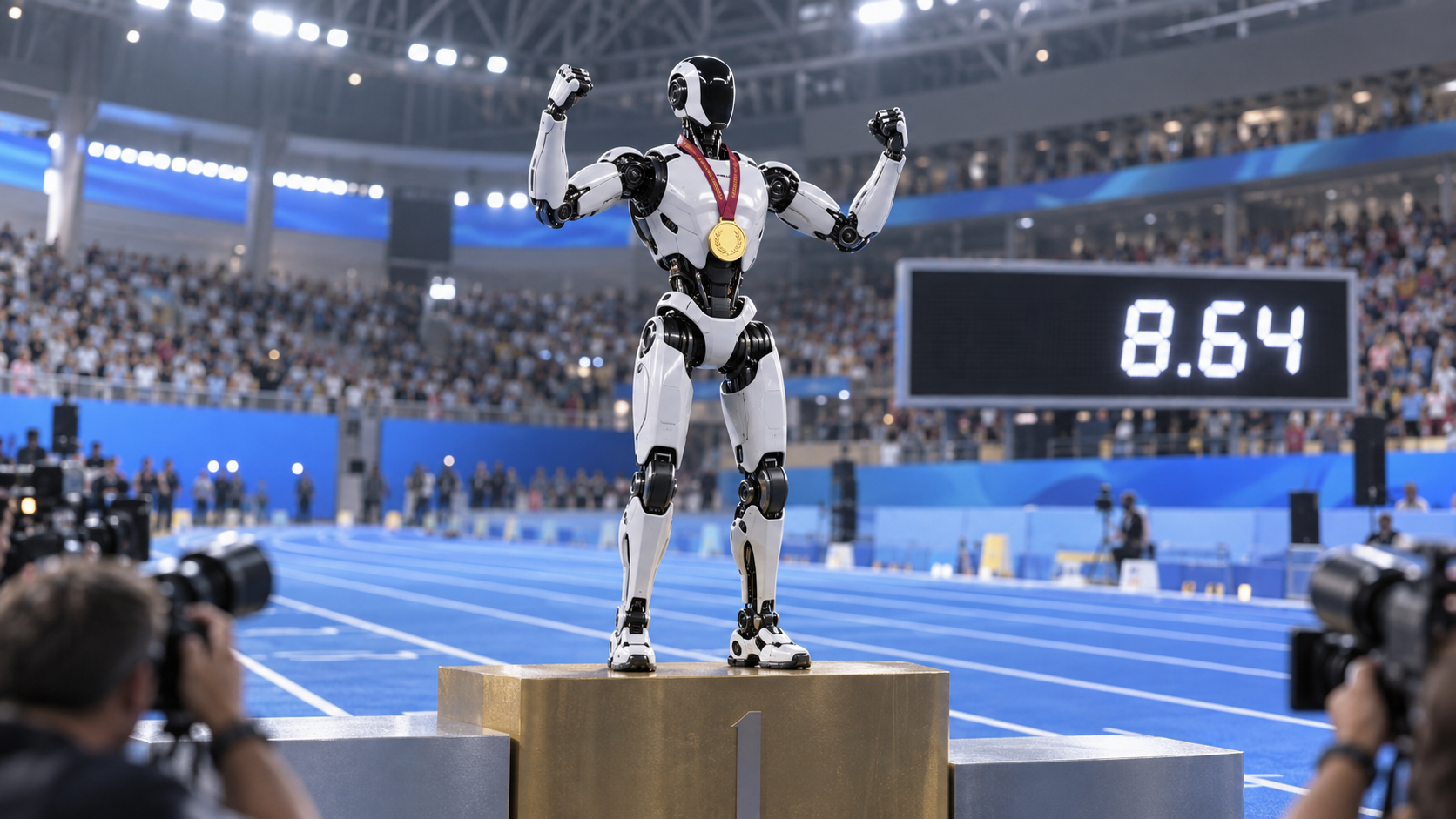
At this year’s event, a robot called Tiangong Ultra completed the 100-meter dash in just 8.64 seconds.
For comparison, Usain Bolt set the human world record of 9.58 seconds at the 2009 World Championships in Berlin. That means Tiangong crossed the finish line nearly a full second faster than the fastest human who ever lived.
Image: Dextero
And it wasn’t the only robot rewriting the record books.
Chinese robots also reportedly beat human records in the 400 meters, 1,500 meters and high jump.
But the most remarkable number might be 21.50 seconds, which is how long it took Tiangong to run 100 meters at last year’s Robot Games.
In other words, engineers cut its time by nearly 60% in just 12 months.
That kind of improvement doesn’t come from simply installing a faster motor.
Running on two legs is an incredibly complicated balancing act.
With every stride, a robot has to calculate where to place its foot, how much force to apply and how to keep its body upright.
And it has to make those adjustments in real time.
A tiny mistake at low speed could cause a robot to stumble. At high speed, it could send the robot flying into a wall.
That’s actually what happened to several robots at the games. They crashed into padded barriers because they still hadn’t learned how to stop safely.
After its 8.86-second semifinal run, Tiangong slammed into a thick mat placed beyond the finish line. The impact caused it to collapse and briefly sparked a small fire in its torso.
So while these machines have vastly improved since last year, they still aren’t ready to challenge humans at the Olympics.
Yet.
But winning medals isn’t the real goal here.
China designed the World Humanoid Robot Games to test how quickly robots are improving and prepare them for work in the real world.
This year’s event was much larger than the first.
It brought together 2,056 robots from 666 teams, up from roughly 500 robots and 280 teams last year.
Over five days, they competed in 51 different challenges. Some were crowd-pleasing events like soccer, boxing, dancing and weightlifting.
But nearly half tested skills robots will need in factories, restaurants, offices and homes.
One challenge even required them to plug a charging cable into an electric vehicle, which sounds a lot easier than running 100 meters at a world-record pace.
And for humans, it is.
We can glance at a charging port, recognize its shape and fit the plug into place without giving it much thought.
But a robot has to break that simple movement into a long series of decisions.
It has to locate the charging port, estimate its distance and angle, position its hand correctly and apply just enough force to insert the cable without damaging anything. And if the plug doesn’t go in on the first attempt, it has to recognize what went wrong and try something different.
That’s where many humanoid robots still struggle: figuring things out on the fly.
And that’s why autonomy is so important.
Some robots at the games were remotely controlled or received limited instructions. But more than 40% of the challenges required them to operate entirely on their own.
That’s what companies ultimately need if they want humanoids stocking shelves, moving parts through factories or entering dangerous areas.
And China is building an enormous testing ground to develop that autonomy.
Every success and failure produces data engineers can use to improve the next generation.
And with more than 2,000 robots competing, they can test hundreds of designs at once.
China is also backing this experimentation with serious money.
As the games got underway, electric vehicle maker XPeng announced that its robotics division had raised more than $900 million at a valuation above $6.3 billion.
XPeng plans to improve its hardware and AI, collect more training data and build new manufacturing facilities. By the end of this year, it hopes to produce 1,000 IRON humanoids every month.
Image: Xpeng
The first machines will work in stores and factories, with broader commercial sales planned for 2027.
Those early deployments will give XPeng even more real-world data, creating the same test, learn and improve cycle we saw at the games.
Here’s My Take
Humanoid robots haven’t exactly taken over the Chinese economy.
The country reportedly sold only about 12,000 of them last year. And most went to universities, laboratories and companies testing the technology rather than businesses deploying them in day-to-day operations.
But last year’s Robot Games gave us a valuable benchmark for how quickly that could change.
Back then, we saw machines that could barely make it down a track without falling over. Twelve months later, and one of them just outran Usain Bolt.
And soon, some of them could be clocking in for work.
Regards,
Ian King
Chief Strategist, Banyan Hill Publishing
Editor’s Note: We’d love to hear from you!
If you want to share your thoughts or suggestions about the Daily Disruptor, or if there are any specific topics you’d like us to cover, just send an email to [email protected].
Don’t worry, we won’t reveal your full name in the event we publish a response.
So feel free to comment away!
Disclaimer: This story is auto-aggregated by a computer program and has not been created or edited by finopulse.
Publisher: Source link