In a recent issue, I compared today’s AI boom to the infrastructure buildout that powered the early internet.
I still think that’s one of the best ways to understand what’s happening now.
Telecom companies spent hundreds of billions of dollars laying fiber in the late 1990s, and today’s technology giants are pouring unprecedented sums into chips, networking equipment, data centers and electricity for a similar reason.
They believe they’re building the backbone of the next technological revolution.
But there’s another similarity I want to address.
For the past year, I’ve argued that artificial intelligence would eventually become too important for the U.S. government not to intervene.
And I believe we’re seeing that prediction start to come true.
Building the Backbone of AI
Last month, Nvidia announced a partnership that shows just how much the AI infrastructure boom has changed.
The company is teaming up with Apollo, BlackRock, Blackstone, Brookfield, Goldman Sachs and KKR, some of the biggest names in finance, to help raise more than $500 billion for AI infrastructure.
And Nvidia could put some of its own balance sheet behind those projects.
CEO Jensen Huang said the company could ultimately backstop as much as $125 billion, or roughly 25% of the potential deals.
In other words, Nvidia isn’t simply selling the chips that power AI anymore. It’s helping create the financial system needed to pay for everything around them.
We’ve already seen why that kind of financing is becoming necessary.
In August, Nvidia agreed to provide as much as $105 billion in financial guarantees tied to OpenAI’s leases at a massive AI campus being developed by SB Energy in southern Ohio.
Nvidia is also investing $1.5 billion in SB Energy and will supply the chips and networking equipment for the project.
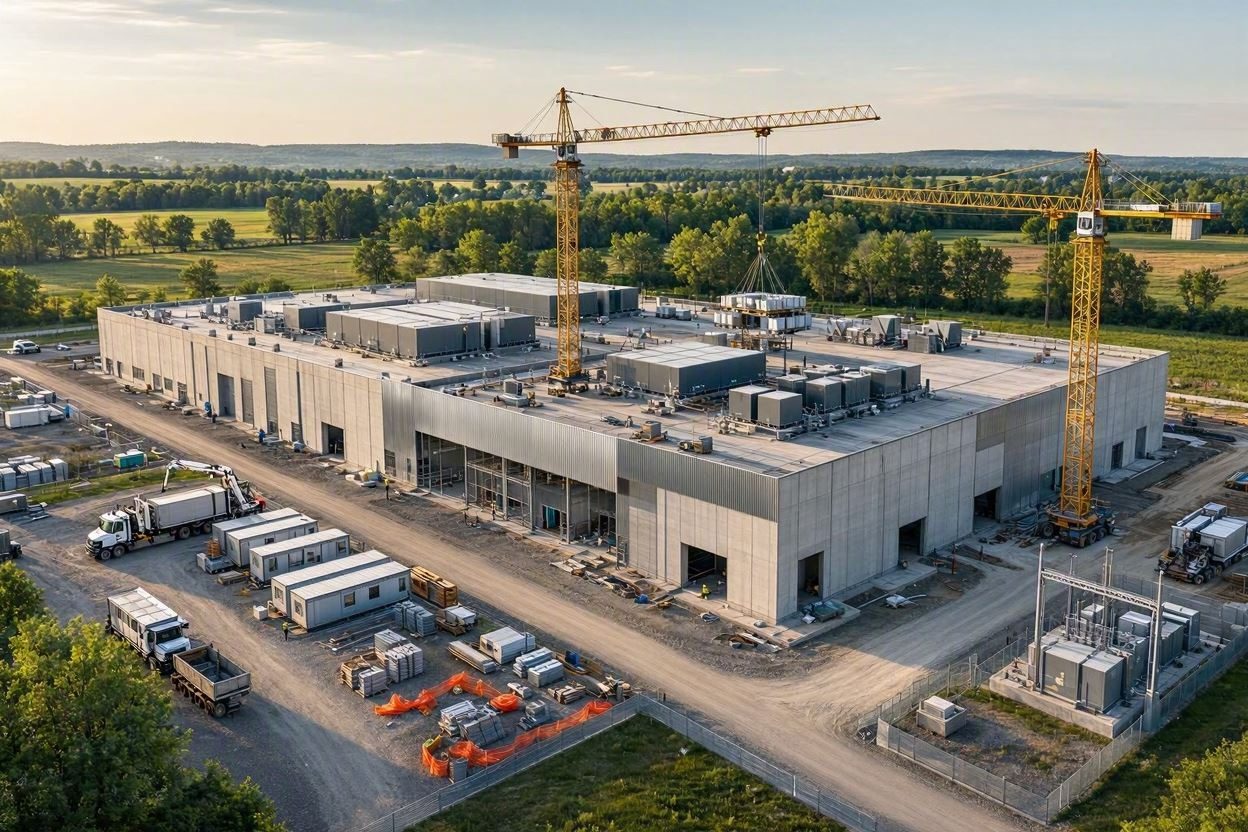
OpenAI has committed to lease 8 gigawatts of computing capacity at the site for 20 years. That’s enough power for several million homes.
But it’s only part of a much larger plan.
SB Energy and AEP Ohio are also planning $4.2 billion in new transmission infrastructure to support the project.
Earlier estimates suggested a campus this large could cost at least $500 billion, illustrating just how expensive the AI infrastructure race has become.
And projects this large can’t be built by technology companies alone.
They require enormous amounts of capital, electricity, transmission capacity and land. They can also require cooperation from the federal government.
That’s true in Ohio, where the Department of Energy (DOE) is leasing federal land at the former Portsmouth uranium enrichment site to the SB Energy affiliate developing the campus.
But it’s not the only place where Washington is becoming more involved in America’s AI buildout.
The DOE is also moving ahead with its Genesis Mission.
This program brings together government labs, universities and companies to use AI to speed up scientific research.
Genesis includes all 17 DOE National Laboratories and five National Nuclear Security Administration sites.
So far, the DOE has selected 278 projects involving 342 institutions. Its partners have also committed more than $800 million in computing power, AI models, cloud services, research support and funding.
And just last week, the DOE announced another Genesis project aimed at using AI to help utilities expand America’s electrical grid faster.
That’s a very different role for the government than simply regulating AI.
For much of the AI boom, Washington’s most visible role was setting the rules. It restricted exports of advanced chips, debated safety standards and tried to limit China’s access to American technology.
Now the government is increasingly helping build the infrastructure behind AI too.
Washington is also beginning to treat that infrastructure as a national-security asset.
Last month, it was reported that the Trump administration is drafting restrictions on imports of Chinese-made equipment used inside American data centers.
The concern is that once foreign technology becomes embedded inside critical infrastructure, removing it can be difficult and expensive.
America learned that lesson with telecommunications equipment. And Washington clearly doesn’t want to repeat it with AI.
Of course, China has long treated artificial intelligence and the infrastructure around it as national priorities.
We’ve seen that approach in everything from semiconductors and robotics to China’s enormous investments in electricity and advanced manufacturing.
The U.S. is taking a different path.
Rather than following Beijing’s state-directed model, Washington is increasingly working with private companies, universities and Wall Street to build the AI infrastructure America needs.
Here’s My Take
I’ve written several times this year about China’s growing advantages in the AI race.
And frankly, some of what I’m seeing still concerns me.
China has invested heavily in its power grid, advanced manufacturing, robotics and other physical infrastructure that AI increasingly depends on.
Meanwhile, America’s aging power grid has become one of the biggest bottlenecks facing our own AI buildout.
But what we’re seeing now makes me more optimistic.
The U.S. government isn’t trying to copy China’s playbook.
Instead, it’s starting to build on the advantages America already has.
We have the world’s leading AI companies and the world’s largest capital markets. We have world-class universities and national laboratories. And we have some of the world’s most advanced computing and energy resources.
Washington is finding ways to bring those pieces together.
And I’m excited to see that it’s finally starting to happen.
Regards,
Ian King
Chief Strategist, Banyan Hill Publishing
Editor’s Note: We’d love to hear from you!
If you want to share your thoughts or suggestions about the Daily Disruptor, or if there are any specific topics you’d like us to cover, just send an email to [email protected].
Don’t worry, we won’t reveal your full name in the event we publish a response. So feel free to comment away!
Disclaimer: This story is auto-aggregated by a computer program and has not been created or edited by finopulse.
Publisher: Source link