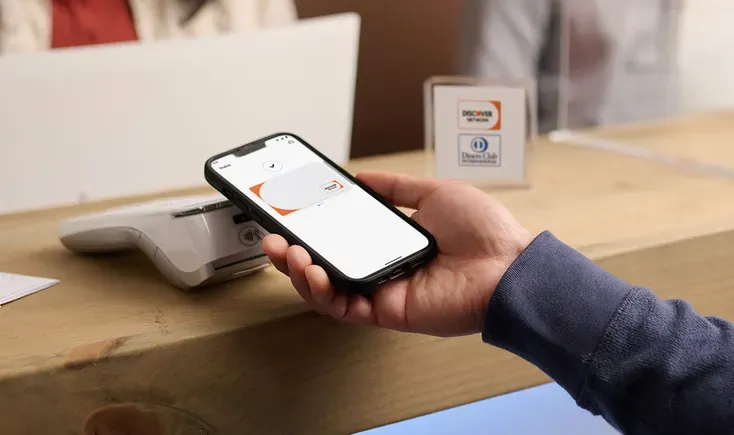
Whether they’re shopping online or in person, consumers have more payment choices than ever before. With emerging payment methods like digital wallets, buy now, pay later (BNPL), and account-to-account (A2A) payments gaining momentum, strategically integrating these solutions can help merchants and acquirers unlock new growth opportunities and deliver the seamless, flexible shopping experiences their customers demand.
Shoppers expect a variety of payment options
Consumers increasingly expect to use the payment method of their choice, including digital wallets on their smartphones, contactless cards, and wearable payment devices. The Discover® Network commissioned 2025 Payments State of the Union research found that 61% of consumers had used a digital wallet in the previous 90 days, and 35% had used a BNPL service.
Many consumers also expect to use A2A payment tools like Zelle, PayPal, Venmo, WeChat Pay, Alipay, and Cash App to make purchases, not just transfer money between individuals. McKinsey’s 2025 Global Payments Report notes that the popularity of A2A payments is on the rise, especially through digital wallets. Some parts of the world have adopted A2A payments for purchases more quickly than others.
According to UK Finance, the share of e-commerce transactions through instant A2A rails has reached 68% in Poland and 64% in the Netherlands; the U.K. has been slower to embrace this trend.
No matter where you do business, the days when merchants only needed to accept cash and cards are long gone. Seven in 10 (70%) merchants now recognize that offering a wide variety of payments options is important to the success of their business, another finding from the 2025 Payments State of the Union research.
Composable commerce supports a wide range of payment solutions
For merchants looking to create seamless omnichannel experiences that support a variety of payment options, composable commerce technology provides the behind-the-scenes functionality that enables consumers to shop online and pay with their preferred method. As Andrew Gordon, eCommerce payments strategist at Discover Network, explained to PYMNTS, composable commerce empowers merchants to adopt a more agile and innovative approach to eCommerce, leading to better customer experiences across all channels.
Composable commerce technology enables the building of digital storefronts by selecting and connecting best-of-breed, modular software components via APIs (like building with digital LEGO bricks), rather than using a single, inflexible "all-in-one" platform. This allows merchants to deploy the tools and solutions that best meet their customers’ needs and preferences.
Composable commerce also allows businesses to more seamlessly integrate various payment options, including digital wallets and BNPL.
For example, API-based architecture makes it possible for a merchant to connect its mobile app and desktop store to the same customer relationship management (CRM) software and payment gateway.
Social commerce demands flexible, frictionless payment options
Implementing emerging payment methods such as digital wallets, BNPL, and A2A via composable commerce can empower merchants to engage with customers through a powerful and dynamic new channel: social commerce. This integrated experience allows shoppers to find and purchase products within social media platforms.
Whether it’s a product endorsement from an influencer with millions of followers or an affiliate program featuring recommendations from a trusted brand, social commerce delivers a more personalized and interactive experience for shoppers, who can engage directly with brands and influencers via their social channels.
Social commerce also helps merchants enhance their digital footprints and drive sales, but they’ll need to offer frictionless, secure payment options beyond credit and debit cards to capitalize on these opportunities. According to the research from Discover Network, 22% of merchants are looking to deepen their expertise in social commerce, while 49% believe they need to enable purchases in alternative channels, such as social media, to convert more online shoppers.
Partners can help merchants adopt new payments solutions
Keeping up with the rapid evolution of technology and consumers’ expectations presents a challenge for merchants. Fortunately, partnering with payment networks, acquirers, enablers, and other payments integration providers can help merchants expand into new payment channels.
The vast majority (94%) of merchants agree that partnerships with payment networks/providers are important for meeting their customers’ needs, Discover Network research found.
One such partner is Bluecode, a mobile payment scheme that enables cashless payments via mobile phones to support global payment interoperability. Bluecode also connects loyalty programs with payments, improving convenience and saving time for both shoppers and merchants. Another similar partner is Softpay, whose SoftPOS solution turns any NFC-enabled device into a payment terminal. Softpay provides mobile payment solutions to retail, transportation, and hospitality businesses across Europe.
As consumers’ shifting preferences and expectations drive global payment trends, it’s clearer than ever that merchants must adopt new payment solutions to keep up.
From implementing new commerce architecture to working with partners that can enable emerging payment methods, the current global payments ecosystem offers merchants a multitude of ways to evolve their payments infrastructure.
To learn more about how Discover Network supports emerging payment solutions, visit discoverglobalnetwork.com.
Disclaimer: This story is auto-aggregated by a computer program and has not been created or edited by finopulse.
Publisher: Source link